Tools
Trading journals, risk guard, track record and more.

"Infinite Possibilities"


 2021
2021Payment Methods
Compatible Platforms





Duration
Drawdown Type
DAILY LOSS
NoMin Days
1 day
Consistency
-
News
Schedule
MARKET DATA
Drawdown Type
Drawdown lock
DAILY LOSS
Not an instant failInactivity
Instant failActivation deadline
News
Scaling Contracts
Multi-Account
Microscalping
PROHIBITED
Profit Split
Min Withdrawal
$500
Maximum Withdrawal
Buffer
Consistency
Min Days
PAYOUT CAP
TIME TO GET PAID
GETTING PAID OUTSIDE THE US
Withdrawal Methods
 PlanePlane
Maximum 6 payouts per account. Fixed amounts per payout. They review the request within 2 business days and send within 3-4; counting your bank, 5-11 business days is typical. Outside the US you get paid via Plane and your bank must be in your declared country of residence, or the request is rejected. Apex does not issue tax forms to non-US members.
Apex runs a real-money trading desk separate from the simulated side. You cannot apply: Apex picks you and notifies you by email.
You cannot hold Live and simulated accounts at the same time. When you are selected, every evaluation and every PA you own is closed. Only evaluations still active at that moment are refunded, not ones you had already blown.
Selection
Split
Live payouts
Live accounts
Parameters
Bonus Vault
Apex can change the Live program terms at any time and without notice. Their user agreement and the paperwork you sign on entry are what actually govern.
Visit Apex Trader Funding's help center
Help centerApex Trader Funding does not accept traders from the following countries:
| Instrument | Code | Round Trip |
|---|---|---|
E-mini S&P 500 | ES | $3.98 |
E-mini NASDAQ 100 | NQ | $3.98 |
E-mini Russell 2000 | RTY | $3.98 |
E-mini Dow Jones | YM | $3.98 |
Micro E-mini Russell 2000 Micro | M2K | $1.02 |
Micro E-mini S&P 500 Micro | MES | $1.02 |
Micro E-mini NASDAQ 100 Micro | MNQ | $1.02 |
Micro E-mini Dow Jones Micro | MYM | $1.02 |
Reviews
My quick take: Apex is the firm where I've had 33 PA (Funded) accounts out of 157 evaluations bought over the years, with one-off withdrawals of $500-$1,000. It is the firm with the most years in the sector and up to 20 simultaneous accounts, though today it no longer makes my top 5 of best-rated firms. 100% profit split always, up to 20 simultaneous accounts and a 5-year track record of paying out. My score: 8/10. The downsides: fixed withdrawal caps per payout and the time it takes for the money to reach your bank after approval.
With the certificate the firm issued
Apex is one of the firms with the most history operating in the futures segment: 5 years of delivering and over $500M paid to traders since 2022. I've been trading with them for years and have had 33 PA (Funded) accounts out of 157 evaluations bought in that time. My withdrawals with them have been occasional: $500 and $1,000, both backed by a certificate from Apex itself. More than one account blew up shortly after a withdrawal because I pushed the risk to go faster. It is not sustainable, and I still struggle to avoid it. But the fact is clear: Apex pays, and it's been doing so with me for years.
What I like most are the affordable evaluations. Apex almost always has an 80-90% discount active with the code ETFPROMO. The 50K Intraday drops from $249 to about $25. That lets you make mistakes without paying a high cost: you can take several attempts while you find your system, and the big outlay only comes once you're funded and about to pull profit. Makes sense, right? You pay little while you learn, you pay more once you're withdrawing.
On top of that comes what you already know about Apex: 20 real simultaneous accounts (the only firm in the catalog that allows it) and 100% profit split always. Multiplied across several accounts in parallel, the math changes: with Apex you leverage up with accounts, not with contracts.
What I don't like are the fixed withdrawal caps per payout (on 25K only $1,000 per payout) and the actual processing time: withdrawal approval is almost instant —on my last withdrawal it took a few minutes to be approved—, but the money takes quite a while to reach your personal account: it reached me about two weeks after approval. The Plane → bank handling adds friction that isn't present at every firm. The cap of 6 payouts per account also forces you to run several in parallel.
Apex 4.0 (March 1, 2026) changed a lot: they removed monthly fees, the 5:1 rule and the one-direction rule. For new clients the system runs clean. For Legacy PA holders the Plane transition still has friction, that has to be said.
My top 5 moves with the ratings, so it is always up to date in the top-rated ranking. Apex no longer makes that top 5, but the proven track record and the multi-account leverage up to 20 accounts still have no rival.
Pros
Cons
Comparison of the three big names in the multi-account segment at 50K, with the discounts active at ElTraderFinanciado (verified May 2026):
| Metric | Apex Intraday 50K | MFF Rapid 50K | Bulenox Qualification 50K |
|---|---|---|---|
| Price without discount | $249 | $209 (one-time payment) | $175 (one-time payment) |
| Discount | -90% flash (ETFPROMO) | -50% on your first 4 purchases (ETFPROMO) | -89% lifetime (ETFPROMO) |
| Final eval price | $24.90 | $104.50 | $19.25 |
| Activation fee | $59 | $0 | $148 |
| Total cost to funded (1 attempt) | $83.90 | $104.50 | $167.25 |
| Drawdown 50K | Trailing intraday | Trailing intraday | Trailing intraday |
| Profit split | 100% always (max. 6 payouts) | 90% | 100% first $10K |
| Withdrawal frequency | Every 5 days | Daily | Every 10 days |
| Withdrawal cap 50K | $1,500-$3,000 per payout | No effective cap | $1,500 |
| Simultaneous accounts | 20 | 5 | 5 |
| Trustpilot | 4.2 / 20,685 | 4.9 / 20,877 | 4.7 / 1,768 |
The real cost depends on how many attempts you need. At first glance MFF looks like it wins on total cost, but there's a nuance you only get after a while in this: you rarely pass an evaluation on the first try. Until August 2026 MFF billed by the month and taking longer meant stacking payments; since 25 August its evaluations are one-time payments, just like Apex's, so the clock no longer punishes the slow trader at either firm. What remains as a structural difference is the activation fee: Apex charges it when you get funded, MFF never charges one. If you expect several attempts, compare Apex's evaluation price plus its activation fee against MFF's price on its own.
💡 Apex's -90% is a flash offer expiring soon. Check the current percentage before paying at /discounts.
Apex has two very different ideal profiles:
1. The trader who is starting out or isn't consistent yet. Evaluations at $20-30 with the discount let you burn through several attempts without going broke. Since the activation fee is only paid when you pass to funded, the cost per attempt is minimal. If you need 3-5 attempts to pass the evaluation —something normal when you're still finding your system—, the total cost ends up being lower than at firms with a $0 activation fee but pricier evaluations per attempt.
2. The consistent trader who knows how to spread risk across many accounts. This is where Apex shines with the 20 simultaneous accounts and the 100% initial profit split × each account in parallel.
I'd recommend it if:
I wouldn't recommend it if:
If you're starting out with Apex, go for the 25K Intraday. It's the cheapest plan in the catalog and the best training ground to understand the system:
If you already have experience and withdraw consistently, the calculation changes:
And the phrase I always repeat about Apex: leverage up with accounts, not with contracts. It's where that idea makes the most sense in the whole sector.
69 global ratings
Traders say: coming soon — automatic summary once there are 10+ text reviews.
Share your experience with other traders
Showing 5 of 69 reviews
D***l
J***8
A***a
C***o
j***g
Other prop firms you might be interested in
Trading without a record?
Trading journals, risk guard, track record and more.
About to pay list price?
Up to 90% off at the best prop firms, checked daily.
Which one actually pays off?
By price, value for money, your level or rating.
Apex Trader Funding is a futures prop firm based in the USA, founded in 2021. It works as a prop firm: you pass its evaluation by trading CME futures (NQ, ES, MNQ, etc.) on platforms such as NinjaTrader, Tradovate, TradingView, Rithmic or WealthCharts, and upon approval you get a sim funded account with its capital.
The profit split is always 100% for the trader. It has 20,685 reviews on Trustpilot with 4.2/5, one of the largest samples in the industry.
Apex is not a broker - it is a futures prop firm. The difference matters: a broker gives you access to the real market with your own capital. Apex funds you a simulation account with its capital after passing an evaluation, and shares with you 100% of the profit.
The reference platforms that connect to the market data provider include NinjaTrader, Tradovate, TradingView, Rithmic and WealthCharts, among the 15 platforms Apex integrates in total. If you are looking for a broker to trade with your money, Apex is not the answer. If you're looking to trade futures without risking more than the evaluation fee, it does fit the bill.
Apex Trader Funding has been in business since 2021 with a rating of 4.2/5 on Trustpilot and 20,685 verified reviews. It is one of the largest futures prop firms in the US market, with documented payouts to thousands of traders. Not a scam, but it is worth reviewing the key rules:
Trailing drawdown $2,000 on $50,000 account. Consistency rule 50% (no day can exceed 50% of the total accumulated profit). Activation fees from $69 (Intraday) or $119 (EOD) depending on size.
As of March 2026 (Apex 4.0), the Intraday and EOD plans do not charge a monthly fee. Each evaluation is a one-time fee: you pay only once for the account and the operation continues until you pass it, burn it or cancel it.
Exception: the Legacy plan (reintroduced in 2026) is still monthly — from $197/month on 50K — with $2,500 drawdown, up to 10 minis and a 30% consistency rule.
Current pricing for the Intraday plan (drawdown trailing intraday): 25K = $167, 50K = $249, 100K = $399, 150K = $599.
EOD plan prices: 25K = $450, 50K = $550, 100K = $990, 150K = $1890.
A one-time activation fee (between $69 and $159 depending on size and plan) is payable upon passing the evaluation. Current discounts can be found at `/discounts/apex-trader-funding`.
Yes, Apex pays. It is one of the most widely sampled futures prop firms: 20,685 reviews on Trustpilot with 4.2/5.
Withdrawals are processed every 5 trading days on funded accounts, with a minimum of $500 per payout. Profit split is always 100%. Available payment methods: Plane and ACH.
A 50% consistency rule applies when requesting payouts (your most profitable day cannot exceed 50% of the total accumulated profit) and a minimum of 5 trading days in funded account before first withdrawal.
Apex charges a one-time activation fee when moving from evaluation to funded account. Varies by plan and size:
Intraday Plan (DD trailing intraday): 25K = $69, 50K = $79, 100K = $99, 150K = $129.
EOD Plan (DD trailing EOD): 25K = $119, 50K = $139, 100K = $149, 150K = $159.
This is a one-time fee: it is paid only once when the funded account is activated for the first time. It is not recurring.
Upon passing the evaluation and activating the funded account, Apex charges a one-time activation fee between $69 and $159, depending on the plan (Intraday vs. EOD) and account size.
It is a one-time (non-recurring) fee: paid only once when activating the funded account for the first time. The monthly fee was eliminated with Apex 4.0 - the entire model is now one-time fee.
Full table of activation fees by size and plan in `/review/apex-trader-funding`.
Apex Intraday and EOD are differentiated by the drawdown type.
Intraday uses real time trailing drawdown (moves with each tick - stricter). Activation fee from $69.
EOD calculates drawdown at close of day (more flexible, allows floating drawdown during the session). Activation fee from $119.
Both share profit split always 100%, 50% consistency rule and minimum 5 trading days before first payout.
$2,000 trailing in both plans (Intraday and EOD). In Intraday it is updated tick by tick during the session. In EOD only at the close of the day.
Above the Safety Net (balance + drawdown + $100), the trailing stops moving. It is the same value as in evaluation and sim funded.
Apex allows trading up to 20 simultaneous accounts - the highest limit in the industry.
This facilitates leveraged strategies by number of accounts rather than by contracts: two $50K accounts with 4 contracts each are equivalent to a larger account with 8 contracts but diversifying the risk of breach.
Who analysed Apex Trader Funding
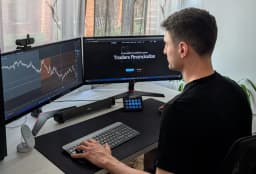
I trade NQ (Nasdaq-100) and ES (S&P 500) futures on micros, scalping and intraday on 1, 5 and 15 minute charts, since 2019.
I execute on NinjaTrader 8 and analyse on ATAS: my decisions come from Order Flow, Volume Profile, VWAP.
I trade live on camera with OBS Studio, Restream.io, RØDE PodMic USB, so you can watch the process as it happens.
I only write about firms I have taken through evaluation and traded live with my own money.