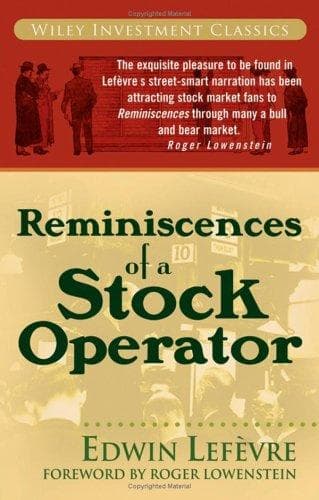
Reminiscences of a Stock Operator
by Edwin Lefèvre
Amazon affiliate links. By using them, you support our free content at no extra cost to you.
The summary
Published in 1923, this book tells in fictionalised form the life of speculator Jesse Livermore. He was one of the most talked-about operators in Wall Street history, and its author, Edwin Lefèvre, was a journalist who wrote the account in the first person after long conversations with him, though character names and some episodes are novelised.
Livermore traded without computers or indicators: he read price and volume off the printed ticker tape — the famous "tape reading" — and relied on an intuition trained over years of wins and bankruptcies. The book follows his path from his early bets in the "bucket shops" to his large-scale operations, along with the rises and the ruin that came with them.
What keeps the book being cited a century later isn't the technique — obsolete for today's markets — but the psychological mistakes it describes: adding to a losing position hoping it turns around, ignoring your own plan out of overconfidence after a good run, and trading out of boredom when there's no real opportunity. These are failures that happen just as often today.
It isn't a manual and doesn't try to be: it's a narrative account with lessons left implicit rather than spelled out, so if you're after a step-by-step guide, this isn't the place to start. It works well as background reading, whether you're starting out and want to understand why psychology matters so much, or later on, once you've already lived through some of the mistakes it describes.
About the author
Edwin Lefèvre
American journalist and writer (1871-1943), author of Reminiscences of a Stock Operator (1923), a story inspired by the life of speculator Jesse Livermore.
What You'll Learn
- The psychology behind trading's most repeated mistakes
- Why adding to a losing position usually gets expensive
- How overconfidence after a win leads to losing
- The origins of tape reading, reading price and volume
- That the same failures repeat a century later
Recommended For
- Traders after historical context, not current technique
- Anyone who prefers learning through a told story
- Readers who already recognise some of these mistakes in themselves
- All levels, as background reading
- Anyone wanting to understand why psychology hasn't changed
Details
- Published
- 1923
- Pages
- 288
- Publisher
- Deusto
- ISBN
- 9788423427369