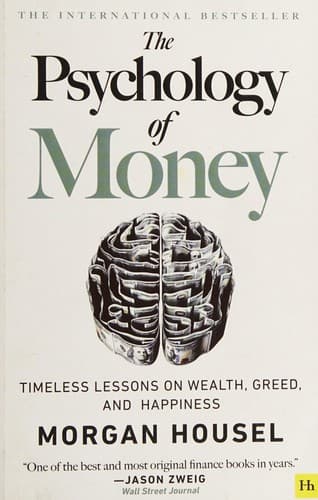
The Psychology of Money
by Morgan Housel
Amazon affiliate links. By using them, you support our free content at no extra cost to you.
The summary
Morgan Housel argues that financial success depends far more on how you behave than on what you know about finance. The book is built from short, standalone chapters, each anchored in a real story, showing how human psychology shapes money decisions in ways no financial model captures.
One of the book's most-quoted data points is that 97% of Warren Buffett's wealth arrived after he turned 65, not from one brilliant investment at a single moment, but from letting capital compound for decades without touching it. Housel uses stories like this to insist that patience and time in the market outweigh finding the perfect trade.
For anyone trading their own capital or a prop firm's, the parallel is direct: you don't need the best setup in the world, you need the discipline to run a reasonable setup for a long time without wrecking it through impatience or overtrading after a good run. Housel rarely talks about trading explicitly, but every chapter on risk, ego or luck carries over to daily trading with almost no translation needed.
It's a read made of short chapters, aimed as much at long-term investors as at intraday or futures traders, because the underlying subject, your relationship with risk and time, is the same on any horizon. It works well both early on, to set the right mindset from day one, and later, once you've lived through some of the biases it describes.
About the author
Morgan Housel
American writer on behavioral finance and a partner at The Collaborative Fund; author of The Psychology of Money.
What You'll Learn
- Why behaviour matters more than technical knowledge
- The role of patience and time in financial results
- How ego and fear distort decisions with money
- The difference between being rich and feeling financially secure
- Common biases when handling gains and losses
- Behavioural habits for preserving capital over the long run
Recommended For
- Traders and investors of any level
- Anyone who wants to understand their own relationship with money
- Traders who have the technical side down but struggle with consistency
- A personal finance read to complement your trading
- Anyone trading prop firm capital who wants a long-term perspective
Details
- Published
- 2020
- Pages
- 312
- Publisher
- Paidós
- ISBN
- 9789584299680